Common Cat Care Myths (and What Actually Matters)
By Scout & Company Companion Pet Care
Cats are often described as independent and low-maintenance, and there’s some truth to that. They don’t need walks, they groom themselves, and they’re generally quieter than dogs. But that reputation has a way of leading people to give them less attention than they need, and that’s where it starts to cause problems.
A lot of what people assume about cats is only partially true. Here are some of the most common myths, and what tends to matter more in practice.
Myth 1: Cats Don’t Need Much Attention
This one tends to get cats wrong in two directions. Some are genuinely independent and prefer limited interaction. Others are deeply social and don’t do well without regular company. The range is wider than most people expect, and assuming every cat falls on the self-sufficient end is where problems start.
What cats consistently need, regardless of personality, is some form of daily engagement. That doesn’t have to mean long play sessions or constant interaction. Even ten to fifteen minutes of intentional play can go a long way in preventing boredom and giving cats an outlet for instinctive behaviors like hunting and chasing.
The American Association of Feline Practitioners notes that environmental enrichment, including play, is one of the most important factors in a cat’s long-term behavioral health. Cats that don’t get enough of it don’t always become visibly distressed. Sometimes they become quieter, more withdrawn, or start redirecting that energy into scratching furniture or disrupting sleep.
Myth 2: Indoor Cats Don’t Need Vet Care as Often
Indoor cats avoid a lot of the risks that outdoor cats face. They’re not exposed to the same parasites, injuries, or infectious diseases. But that doesn’t translate to needing less veterinary care.
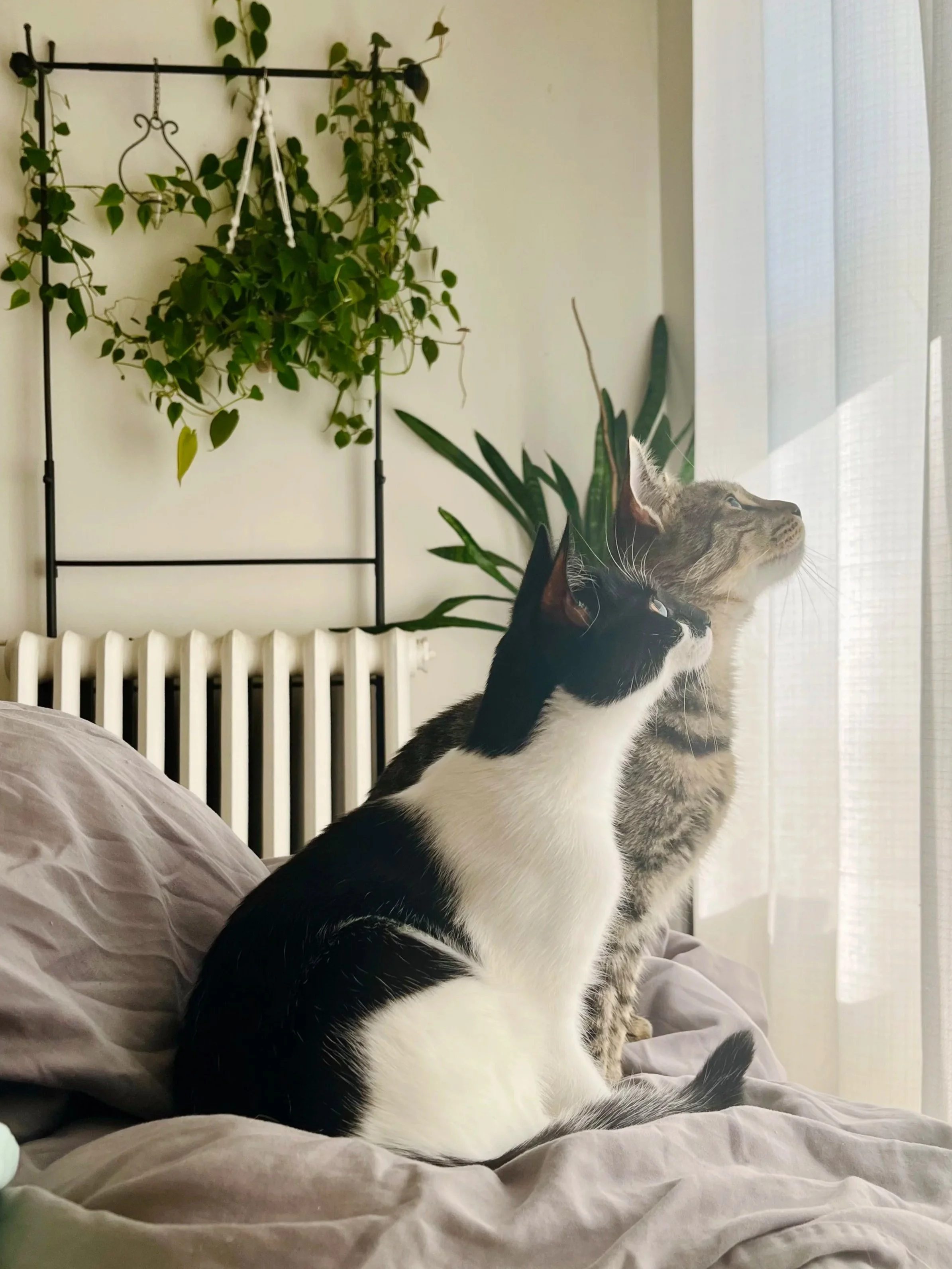
The cutest duo 🐾
Images © 2025 Scout & Company Companion Pet Care. Please do not reuse without permission.
Cats are exceptionally good at hiding discomfort. It’s an instinct rooted in survival. In the wild, showing weakness invites danger, so cats mask pain and illness in ways that can make serious conditions difficult to detect until they’re well advanced. Indoor cats are no exception.
The American Veterinary Medical Association recommends annual wellness exams for cats at minimum, and more frequent visits for older cats or those with known health conditions. Many of the conditions that affect cats most commonly, including kidney disease, hyperthyroidism, and dental disease, develop gradually and are far easier to manage when caught early. A cat that seems fine can still have underlying issues, and routine exams are often the only way to catch them.
Myth 3: Cats Don’t Need Routine
Cats are creatures of habit in ways that aren’t always obvious. They notice when feeding times shift, when the litter box schedule changes, when a piece of furniture moves, or when a new person is in the home. They don’t always react loudly, but they do react.
Stress in cats tends to show up quietly. Decreased appetite, spending more time hiding, changes in litter box behavior, and increased grooming to the point of overgrooming are all common responses to disruption. Because these signs are subtle, they’re easy to miss or attribute to something else.
Consistency in the basics: feeding times, litter box maintenance, and daily interaction gives cats a stable framework that helps them handle disruption when it does happen. Cats with a reliable routine tend to be more resilient when things change, whether that’s a new schedule, visitors, or a move.
Myth 4: A Cat Always Lands on Its Feet, So Falls Aren’t a Concern
Cats do have a righting reflex, an impressive ability to reorient their bodies during a fall. But that reflex has limits, and the belief that cats are somehow immune to fall injuries has led to a significant number of preventable injuries.
Short falls can actually be more dangerous than longer ones in some cases. With a longer drop, a cat has time to fully right itself and spread its body to slow the descent. With a very short fall, there isn’t enough time or distance to do either. The American Animal Hospital Association has documented what’s sometimes called high-rise syndrome, a cluster of injuries cats sustain from falls, including fractures, chest trauma, and dental injuries, that can occur even when a cat lands on its feet.
This matters most for cats with access to open windows, balconies, or elevated outdoor spaces. Window screens that aren’t secured, balconies without barriers, and upper-floor windows left open are all real risks. The reflex is real, but it isn’t a guarantee of safety.
Myth 5: If a Cat Is Eating and Sleeping, Everything Is Fine
Eating and sleeping habits can stay consistent for a surprisingly long time while other things are quietly changing. Cats are good at maintaining the appearance of normalcy, and that’s exactly what makes them harder to read.
The signs that something is off tend to be behavioral before they become physical. A cat spending more time in one spot, less interested in interaction, grooming differently, or moving more carefully than usual are all signs worth noticing. None of them are dramatic, which is why they’re easy to dismiss or explain away.
The Cornell University College of Veterinary Medicine notes that cats often don’t show obvious signs of pain or illness until a condition has progressed significantly. By the time a cat’s eating or sleeping habits change noticeably, something has usually been building for a while. Paying attention to the quieter signals earlier is what makes the difference.
Myth 6: Cats Are Low-Maintenance Compared to Other Pets
Relative to dogs, cats are easier in some specific ways. They don’t need daily walks, they manage their own grooming for the most part, and they’re generally more adaptable to smaller spaces. But easier in some ways doesn’t mean low maintenance overall.
Cats need a clean and stimulating environment, consistent care, regular veterinary attention, and an owner who is paying close enough attention to notice when something is off. That last part is often more difficult with cats, precisely because they’re so good at not showing when something is wrong.
The practical reality is that caring well for a cat requires more active observation than the low-maintenance label suggests. Cats that thrive tend to have owners who treat them less like self-sufficient pets and more like a quiet one that still needs regular check-ins.
Closing
Most of these myths share a common thread: they underestimate cats. Not in the sense that cats can’t handle themselves, but in the sense that their needs are quieter and easier to overlook than those of more expressive pets.
Cats don’t ask for much out loud. Paying attention to the small things like routine, environment, and subtle shifts in behavior is how you hear what they’re telling you in the first place.