The Science of the Walk: Why Daily Walks Matter for Your Dog
By Scout & Company Companion Pet Care
A walk is more than exercise. For dogs, it's one of the primary ways they experience the world.
Most people think of a dog walk as exercise. A way to burn energy, get outside, and check a box on the daily to-do list. And while walks absolutely provide that, they're doing something much more significant for your dog at the same time.
For dogs, a walk is one of the primary ways they experience and make sense of the world. It's sensory, social, and deeply regulating in ways that a backyard or a play session simply can't replicate. Understanding what's actually happening during a walk changes how you think about them — and why consistency matters as much as it does.
Veterinary organizations such as the American Veterinary Medical Association (AVMA) note that regular physical activity and environmental stimulation are important parts of maintaining a dog's health.
The Physical Case for Daily Walks
The physical benefits of regular walking are well established. Consistent movement supports cardiovascular health, helps maintain a healthy weight, and keeps joints mobile over time. The American Animal Hospital Association (AAHA) identifies regular exercise as one of the most important factors in preventing obesity and maintaining overall health in dogs.
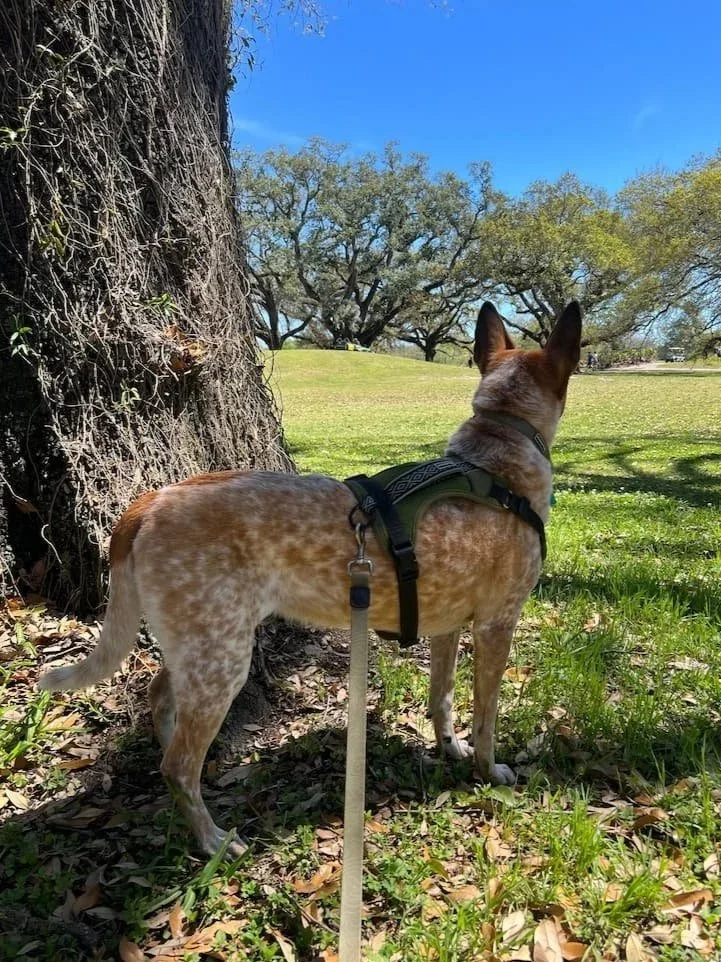
Scout exploring Audubon Park on one of our daily walks
Images © 2025 Scout & Company Companion Pet Care. Please do not reuse without permission.
For younger dogs, daily walks provide a structured outlet for energy that might otherwise find less welcome expressions at home. For older dogs, gentle, consistent movement supports circulation, helps maintain joint flexibility, and can slow some of the physical decline that comes with aging. This is one area where the research is particularly clear: moderate, regular activity over a dog's lifetime has meaningful long-term benefits that sporadic intense exercise doesn't provide.
Consistency is the operative word. A dog walked daily for thirty minutes will almost always be healthier over time than a dog walked for two hours on weekends. The body responds to routine, and so does the mind.
What's Actually Happening in Your Dog's Brain
This is where walks become genuinely fascinating.
Dogs experience the world primarily through scent. Their olfactory system is estimated to be anywhere from 10,000 to 100,000 times more sensitive than a human's, and a significant portion of their brain is dedicated to processing smell. When a dog stops to sniff a patch of grass or a lamppost, they're not wasting time. They're reading a detailed account of who has been there, when, and in what state. It's environmental information-gathering at a level we can barely imagine.
Dr. Alexandra Horowitz, who directs the Dog Cognition Lab at Barnard College and has written extensively on canine perception, describes the walk from a dog's perspective as something closer to reading the newspaper than going to the gym. The scent information available on even a familiar route is constantly changing, constantly new.
This matters because mental stimulation and physical exercise are not interchangeable. A dog that runs in a backyard gets exercise. A dog that walks through a neighborhood, stopping to investigate scents along the way, gets exercise and cognitive engagement. Veterinary behaviorists consistently refer to scent-based exploration as one of the most effective forms of enrichment available to dogs, and enrichment has measurable effects on stress, anxiety, and overall emotional balance.
The practical implication is simple but often overlooked: letting your dog sniff is not a distraction from the walk. It is the walk.
Behavioral Benefits That Extend Beyond the Walk
Dogs who receive consistent physical activity and mental stimulation tend to be noticeably calmer at home. This is not coincidental.
Behavioral issues like restlessness, destructive behavior, excessive barking, and anxiety-driven habits are frequently rooted in unmet needs for exercise and enrichment. A dog who hasn't had adequate stimulation will find ways to meet that need, and those ways are rarely convenient. Regular walks don't just tire a dog out. They give the nervous system what it needs to regulate, which produces the kind of settled, balanced behavior that makes home life easier for everyone.
Veterinary and behavioral experts consistently identify regular walking as one of the first and most effective interventions for dogs showing signs of excess energy or behavioral stress. It's not a cure-all, but it's foundational in a way that's hard to overstate.
The Bonding That Happens Along the Way
There's something that develops between a dog and the person who walks them regularly that's different from other kinds of time spent together. Walking side by side, navigating the environment together, reading each other's cues and adjusting pace and direction — it builds a kind of attunement that translates into the broader relationship.
The American Kennel Club notes that shared physical activities like walking are among the most effective ways to strengthen the bond between dogs and their owners, in part because they involve real communication and responsiveness rather than passive time in the same space. Over time, dogs who are walked consistently by the same person often become noticeably more responsive and connected during those walks, because they've learned to pay attention and trust the person beside them.
How Often and How Long
Most dogs benefit from at least one walk per day, with two shorter walks often working better than one long one. The right frequency and duration depend on age, breed, energy level, and overall health, and those needs shift over a dog's lifetime.
High-energy breeds and younger dogs generally need more: longer walks, more frequent outings, and more opportunities for off-leash exploration when it's safe and available. Senior dogs often do better with shorter, slower walks that prioritize sniffing and gentle movement over distance. What changes with age is the pace and the length. What doesn't change is the need for consistency and the value of getting outside every day.
For any dog, a predictable walking routine provides structure that supports emotional regulation. Dogs are creatures of habit in the best sense. When they know a walk is coming, that anticipation itself is part of the benefit.
Making Walks More Effective
A few small adjustments make a meaningful difference in the quality of a walk for your dog.
Give your dog time to sniff. Build it into the walk rather than pulling them along at a pace that doesn't allow for it. Let them linger on the spots that interest them. A ten-minute walk where a dog gets to genuinely explore is often more satisfying than a thirty-minute walk at a clipped pace where they barely get to stop.
Match the pace to your dog, not your schedule. Some days call for a brisk walk. Others call for a slow meander. Reading your dog's energy and adjusting accordingly makes walks more responsive and more enjoyable for both of you.
Make sure your equipment fits properly. A poorly fitted harness or a leash that's too short can make walks uncomfortable and create tension that works against everything you're trying to build. A good harness with both a back and chest attachment gives you control without restricting movement or causing chafing.
Keep timing as consistent as possible. Dogs do well with predictability, and a walk that happens at roughly the same time each day becomes part of a rhythm that supports their overall sense of security.
A Note from Scout & Company
Walking dogs is the foundation of what we do at Scout & Company, and it's something we take seriously. Every dog we walk gets a genuine outing: time to move at their own pace, follow their nose, and engage with the world around them. That's not a bonus feature of a good walk. It's the whole point.
If your dog isn't getting the consistent walks they need, whether because of a demanding schedule, long work hours, or anything else life brings, we'd be glad to help. You can learn more about our dog walking services and what a regular routine with Scout & Company looks like.