Halloween with Pets: Costumes and Safety Tips
By Scout & Company Companion Pet Care
Halloween in New Orleans hits differently. This is a city that takes celebration seriously, and October 31st is no exception. The streets fill up, the costumes get elaborate, and the energy runs high well into the night. It's one of the best times of year to be here, and one of the more challenging nights to navigate with a pet.
Whether your dog or cat is joining the festivities or staying home while you do, a little preparation goes a long way. Here's what's worth knowing before Halloween arrives.
Pet Costumes: Comfort Comes First
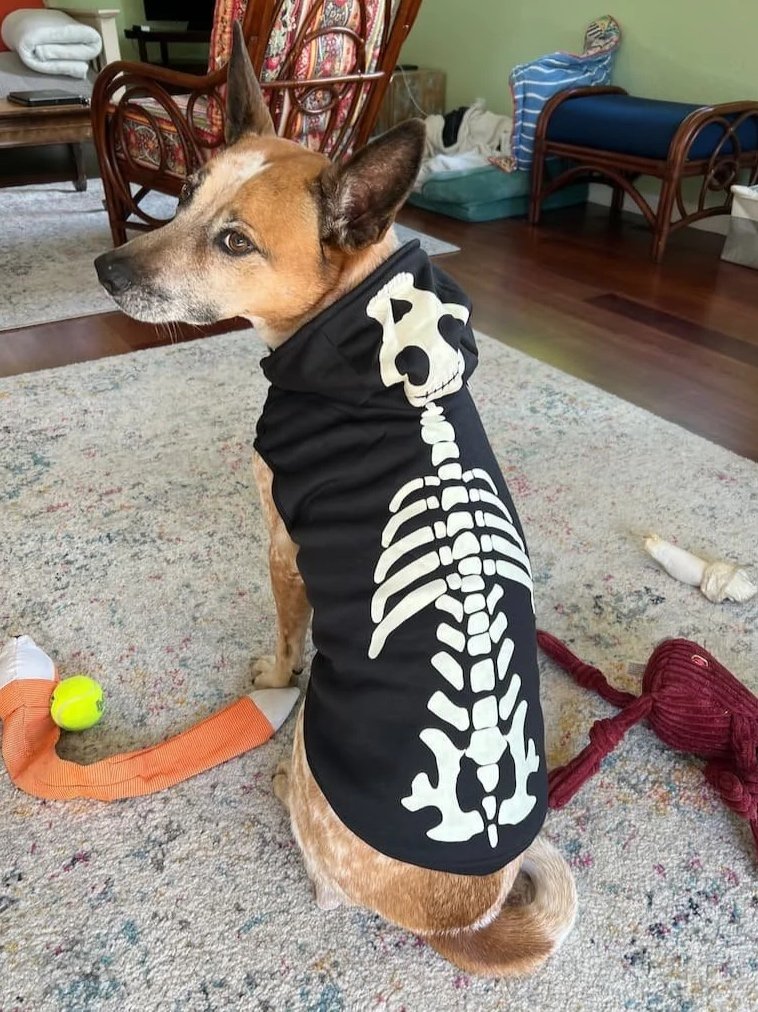
Scout getting festive in her skeleton hoodie (comfort first, of course) 🐾💀
Images © 2025 Scout & Company Companion Pet Care. Please do not reuse without permission.
Dressing up a pet can be one of the more delightful parts of Halloween, especially when the pet is comfortable participating. A well-fitted costume can make for great photos without compromising comfort. A poorly fitted one can be stressful, restrictive, or even dangerous.
A few things to keep in mind when choosing a costume:
It should allow full range of movement without restricting legs, neck, or breathing. Nothing should cover the eyes or limit peripheral vision. Avoid anything with small decorative pieces that could be chewed off and swallowed. And pay attention to how your pet responds when they're wearing it. Flattened ears, a tucked tail, freezing in place, or attempts to remove the costume are all signs they're not comfortable.
Some pets genuinely don't mind costumes. Others tolerate them briefly. And some want no part of it, which is a completely valid outcome. A festive bandana or a themed collar can be a low-pressure alternative that still gets the holiday spirit across.
🐾 Tip: If your pet will be wearing a costume for more than a quick photo, introduce it a few days early. Short, positive sessions with treats help them adjust before the actual night.
Candy Hazards: What's Dangerous for Dogs and Cats
Halloween candy is everywhere on October 31st — in bowls by the door, in bags on counters, and scattered on sidewalks after trick-or-treaters move through. Most of it is harmful to pets, and some of it is genuinely dangerous.
Several common Halloween foods and treats can pose serious risks to pets:
Chocolate — toxic to both dogs and cats. According to the American Animal Hospital Association, chocolate contains theobromine and caffeine, which pets are far more sensitive to than humans. The darker and more bitter the chocolate, the more dangerous it is. Dark chocolate, baking chocolate, and cocoa powder pose the highest risk, but all forms should be kept away from pets.
Xylitol — a sugar substitute found in many sugar-free candies, gums, and baked goods. The ASPCA notes that xylitol causes a rapid drop in blood sugar in dogs and can lead to liver damage in larger amounts. Cats do not appear to be at risk from xylitol, but it remains one of the most serious hazards for dogs during Halloween.
Raisins and grapes — found in some trail mix or snack-style Halloween treats, both are toxic to dogs and can cause kidney failure.
Macadamia nuts — toxic to dogs and sometimes found in cookies, chocolate, and snack mixes. The AAHA includes macadamias among toxic human foods to keep away from pets.
Candy wrappers — foil and plastic wrappers can cause choking, intestinal blockages, and digestive issues even when the candy itself is gone.
If you suspect your pet has eaten something toxic, contact your veterinarian or the ASPCA Animal Poison Control Center at (888) 426-4435 immediately. The ASPCA's toxicologists are available around the clock, and a consultation fee may apply.
🐾 Tip: Evening walks on and after Halloween come with ground-level hazards. A flashlight or headlamp makes it easier to spot dropped candy before your dog does.
Decoration Hazards: What to Watch for Around the House
Halloween decorations add a lot to the atmosphere but introduce a few risks for curious pets that are easy to overlook.
Candles and jack-o’-lanterns — an open flame is a burn risk for pets who get too close, and a knocked-over candle can quickly become a bigger problem. Battery-operated candles are a safer alternative and look just as good.
Fake cobwebs and stringy decorations — synthetic spider webs and similar decorations can be swallowed and cause intestinal blockages, particularly in cats who are drawn to pulling at stringy textures.
Glow sticks and glow jewelry — according to the ASPCA, glow sticks are a particular draw for cats, who frequently bite and puncture them. The liquid inside has an extremely bitter taste that typically causes profuse drooling and agitation. While the reaction can look alarming, the ASPCA notes that the substance is more of an irritant than a serious toxin in the small quantities contained in glow sticks. Offering a treat or small amount of milk usually stops the reaction. If a pet ingests a large amount or seems significantly distressed, contact your veterinarian.
Decorative corn, gourds, and pumpkins — plain pumpkin is non-toxic to dogs and cats according to the ASPCA, but small decorative gourds and corn cobs can become choking hazards or cause an obstruction if chewed or swallowed.
Electrical cords — additional lighting and decorations mean more cords. Keep them secured and out of reach of pets who chew.
Door Safety and Preventing Escape
Halloween creates plenty of opportunities for pets to slip through an open door. The combination of a constantly opening front door, strangers in unfamiliar costumes, and an unusually stimulating environment means that even a calm, well-behaved pet can bolt in a moment of surprise.
A few precautions worth taking before the night starts:
Make sure ID tags are current, and your pet's microchip information is up to date before Halloween. If your pet gets out, that information is what brings them home.
Consider keeping dogs and cats in a separate room away from the front door during peak trick-or-treat hours. A familiar space with their bed, a toy, some background noise, and a long-lasting chew or food puzzle can make that time much more comfortable for them.
If you have a dog who will be near the door, a leash or a baby gate as a secondary barrier adds an extra layer of safety.
For cats especially, this is a night to keep them indoors entirely. The ASPCA recommends keeping cats inside on Halloween, noting the particular risks the holiday presents for outdoor and indoor-outdoor cats.
Not Every Pet Wants to Join the Party
For some dogs, a busy Halloween walk or a neighborhood full of activity is genuinely fun. They enjoy the stimulation, take the costumes in stride, and thrive with a little extra chaos.
For others, it's simply too much. The noise, the crowds, the strangers in unfamiliar outfits, the constant unpredictability of the night - it adds up quickly for sensitive animals. Staying home in a familiar, quiet environment isn't missing out. Sometimes it's the kinder choice, and there's nothing wrong with making it.
Anxious Pets: Keeping Things Calm on a Chaotic Night
For pets who are sensitive to noise, strangers, or unpredictable environments, Halloween can be genuinely overwhelming. A few things that help:
Create a quiet retreat space away from the front door with familiar bedding, a favorite toy, and something that smells like their person. White noise or calming music can help buffer the sounds from outside. If your dog is noise-sensitive, consider skipping the evening walk altogether and doing something lower-key instead. ThunderShirts and similar anxiety wraps can be helpful for some dogs during high-stimulation events.
For pets with more significant anxiety, it's worth planning ahead. A conversation with your veterinarian before Halloween about short-term support options is a reasonable step if previous Halloweens have been particularly hard for your pet.
Dog-Friendly Halloween Treats
If you'd like to include your dog in the celebration in a low-key way, plain pumpkin is a seasonally appropriate option. The ASPCA confirms that plain pumpkin flesh is non-toxic to dogs and cats, and many dogs love it. Plain cooked sweet potato is another safe choice.
Avoid anything with added sugar, spices, artificial sweeteners, or pumpkin pie filling. When in doubt, stick with plain pumpkin. Many pet stores also carry Halloween-themed dog treats and biscuits this time of year if you'd rather keep it simple.
Final Thoughts
However you and your pets spend Halloween this year, a little preparation makes the night a lot smoother. Wishing you and your pets a safe, spooky, and happy Halloween. 🎃